Every high-leverage role demands one thing above all: speed without stupidity.
Founders, strategists, and operators don’t get the luxury of perfect data or unlimited time.
You need frameworks that cut signal from noise—models that turn chaos into confident movement.
This is not a soft take on mindset.
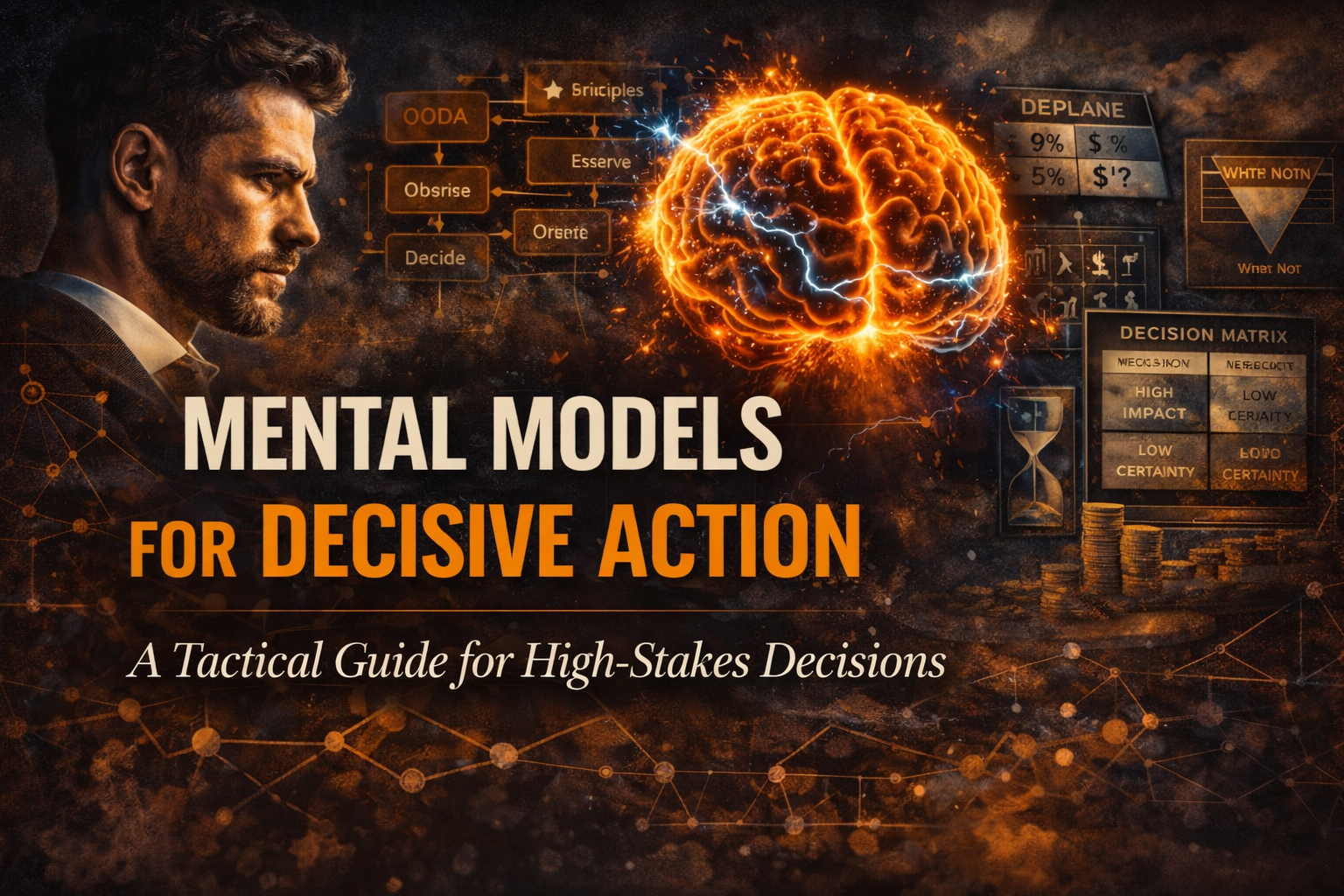
This is a guide to ten field-tested mental models that help you make faster, clearer, and more resilient decisions—especially when stakes are asymmetric.
1. Inversion: Define Failure First
Most people ask, “How do I succeed?” Smart operators flip it: “What would guarantee failure?”
When a fintech team planned their new product, they obsessed over feature sets. But inversion reframed the process: “How do we destroy user trust?” That uncovered risks around onboarding friction and compliance gaps—problems no one flagged before.
Use it when: failure is expensive, and blind spots are likely.
2. First Principles Thinking: Burn It Down to Truth
Copy-pasting competitor tactics is easy. Building from scratch isn’t—but that’s where clarity lives.
Elon Musk famously used first principles to redesign spaceflight economics. In product, a founder might ask: “Why are onboarding flows built this way?” Stripping assumptions led one team to eliminate half their sign-up steps, doubling activation.
Use it when: legacy logic blocks innovation or speed.
3. OODA Loop: Decide Before the Market Does
John Boyd’s military model—Observe, Orient, Decide, Act—was designed for combat. It also wins markets.
One growth lead built pricing experiments on weekly OODA loops. While competitors iterated quarterly, her team had twelve data-informed price moves in one quarter. The result: 3x ARPU.
Use it when: time beats accuracy.
4. 80/20 + Minimum Clarity Threshold: Ship Now, Polish Later
Perfection is expensive. Smart teams predefine their decision bar—then pull the trigger.
An ecomm brand found that one broken form caused 80% of drop-offs. Fixing that one thing gave a 20% lift. No full redesign. Just smart prioritization.
Use it when: you’re stuck in analysis loops.
5. Regret Minimization: Project Yourself Forward
Jeff Bezos used this to leave Wall Street and start Amazon: “At 80, will I regret not doing this?”
A COO used the same lens when debating whether to leave her stable job for a vertical SaaS idea. Fear said no. The model said: regret will be worse than failure. She built a profitable product within 12 months.
Use it when: fear clouds an obvious move.
6. Second-Order Thinking: Map the Chain Reaction
First-order effects are obvious. Second-order ones are where you get blindsided—or gain advantage.
A startup planned to kill a legacy feature to reduce support load. Before pulling the plug, they asked: “Then what?” Analytics showed 7% of power users relied on it. They rebuilt it quietly and avoided silent churn.
Use it when: decisions affect systems, not just outcomes.
7. Skin in the Game: Filter Who You Listen To
No one should have opinion without risk. This model ensures you only take advice from people with something to lose.
Founders often get advice from consultants who’ve never built. One team reoriented around “no equity, no input” and dramatically improved operating focus.
Use it when: advice or decisions come from outsiders.
8. Expected Value: Take Smart Bets Repeatedly
EV = (Odds of Gain × Value of Gain) – (Odds of Loss × Cost of Loss).
A founder considered a $5K experiment with a 25% chance of producing a $50K pipeline. That’s a $12.5K EV. They ran it—and landed two enterprise clients.
Use it when: you’re choosing between bold vs safe.
9. Chesterton’s Fence: Understand Before You Dismantle
If you find a rule and don’t know why it exists, assume you’re missing something.
A dev team removed a logging system to “streamline ops.” Weeks later, a security breach went undetected. The process was protecting more than they realized.
Use it when: you’re tempted to remove legacy systems or constraints.
10. Barbell Strategy: Combine Aggression and Safety
Smart risk isn’t about balance. It’s about extremes.
One founder allocated 80% of spend to stable growth channels, and 20% to moonshots. The core engine funded operations. The moonshots created brand spikes and edge.
Use it when: you want upside without fragility.
Final Word: You Don’t Need More Time. You Need Better Filters.
Most people delay decisions waiting for certainty.
High-stakes operators make decisions at 70% clarity—and move.
Mental models give you that edge.
They compress noise.
They cut decision time.
They minimize downside and amplify upside.
Pick three.
Use them this week.
Rehearse them in small bets.
Build your stack like a toolkit.
Because decisiveness isn’t instinct. It’s engineered.