THE USEFUL ANSWER
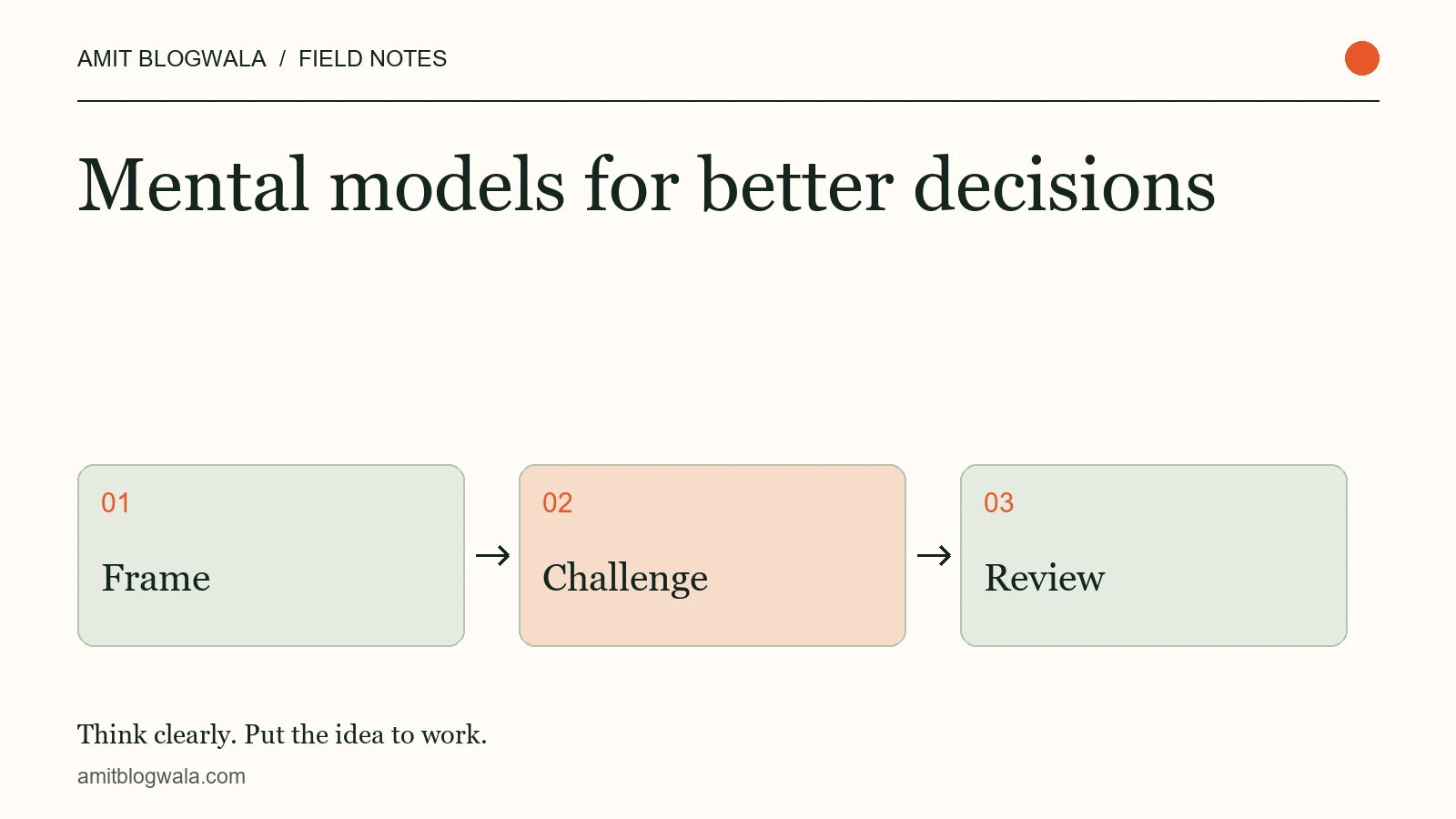
Mental models are prompts for examining a decision from different angles, not formulas that eliminate uncertainty. Use one model to expose an assumption, compare alternatives and record what would justify changing direction. Hypothetical payoffs must remain separate from proven results.
Write the decision, available options and consequences of doing nothing.
Use inversion or second-order thinking to identify failure modes and downstream effects.
Record assumptions, evidence and a date or trigger for revisiting the decision.
Factual review: 16 October 2026. Unverified company anecdotes and performance figures have been replaced with clearly hypothetical examples. The expected-value calculation now separates a cash payoff from sales pipeline and includes the experiment cost.
Every high-leverage role demands one thing above all: speed without stupidity.
Founders, strategists, and operators don’t get the luxury of perfect data or unlimited time.
You need frameworks that cut signal from noise—models that turn chaos into confident movement.
This is not a soft take on mindset.
This is a guide to ten decision-making frameworks that help you make faster, clearer, and more resilient decisions—especially when stakes are asymmetric.
1. Inversion: Define Failure First
Most people ask, “How do I succeed?” Smart operators flip it: “What would guarantee failure?”
Hypothetical example: before adding features, a fintech team could ask what might undermine user trust, then check onboarding and compliance risks.
Use it when: failure is expensive, and blind spots are likely.
2. First Principles Thinking: Burn It Down to Truth
Copy-pasting competitor tactics is easy. Building from scratch isn’t—but that’s where clarity lives.
Hypothetical example: question which sign-up steps are genuinely necessary, then test a simpler flow rather than assuming it will improve activation.
Use it when: legacy logic blocks innovation or speed.
3. OODA Loop: Decide Before the Market Does
John Boyd’s military model—Observe, Orient, Decide, Act—was designed for combat. It can also be used as a business reflection framework.
Hypothetical example: a team could observe customer responses, choose a small pricing test and review its results before another change.
Use it when: time beats accuracy.
4. 80/20 + Minimum Clarity Threshold: Ship Now, Polish Later
Perfection is expensive. Smart teams predefine their decision bar—then pull the trigger.
Hypothetical example: investigate a broken enquiry form before commissioning a complete redesign. Use observed data to choose priorities.
Use it when: you’re stuck in analysis loops.
5. Regret Minimization: Project Yourself Forward
Ask how you might view a decision later, alongside its practical risks and alternatives.
Hypothetical example: compare a new business idea with the costs of leaving a stable job. Reflection does not predict commercial success.
Use it when: fear clouds an obvious move.
6. Second-Order Thinking: Map the Chain Reaction
First-order effects are obvious. Second-order ones are where you get blindsided—or gain advantage.
Hypothetical example: before removing a legacy feature, check who uses it and what depends on it.
Use it when: decisions affect systems, not just outcomes.
7. Skin in the Game: Filter Who You Listen To
Consider an adviser’s incentives, relevant expertise and evidence. Equity ownership is not a prerequisite for useful advice, and a financial stake does not make advice reliable.
Use it when: advice or decisions come from outsiders.
8. Expected Value: Take Smart Bets Repeatedly
Expected value is the sum of each possible outcome multiplied by its probability. In a hypothetical experiment costing $5,000 regardless of outcome, a 25% chance of a $50,000 cash payoff and a 75% chance of no payoff gives an expected payoff of $12,500 and an expected net value of $7,500, before other costs. Sales pipeline is not cash revenue; uncertain pipeline cannot simply be substituted for a guaranteed payoff. The probabilities are assumptions, not forecasts.
Use it when: you’re choosing between bold vs safe.
9. Chesterton’s Fence: Understand Before You Dismantle
If you find a rule and don’t know why it exists, assume you’re missing something.
Hypothetical example: document why a logging system exists before removing it; it may support security, debugging or audit needs.
Use it when: you’re tempted to remove legacy systems or constraints.
10. Barbell Strategy: Combine Aggression and Safety
Smart risk isn’t about balance. It’s about extremes.
Hypothetical example: set aside a limited experiment budget while protecting essential operating commitments. There is no universal budget split.
Use it when: you want upside without fragility.
Final Word: You Don’t Need More Time. You Need Better Filters.
Most people delay decisions waiting for certainty.
The evidence needed should depend on the consequences and reversibility of the decision; there is no universal “70% clarity” threshold.
Mental models give you that edge.
They compress noise.
They cut decision time.
They minimize downside and amplify upside.
Pick three.
Use them this week.
Rehearse them in small bets.
Build your stack like a toolkit.
Because decisiveness isn’t instinct. It’s engineered.
Sources and context
These models are prompts for judgment. The illustrations are hypothetical and do not establish probabilities, financial returns or a proven decision advantage.
No independent performance study is claimed for this commentary. The exercise is an original editorial suggestion.
Continue with more articles from Amit, or explore the current ways to work together.