THE USEFUL ANSWER
Treat LinkedIn growth advice as something to test, not a universal algorithm rule. A clear profile, useful content and relevant professional conversations are more actionable than an unsupported reach hack. Distinguish LinkedIn's published policies from personal experiments.
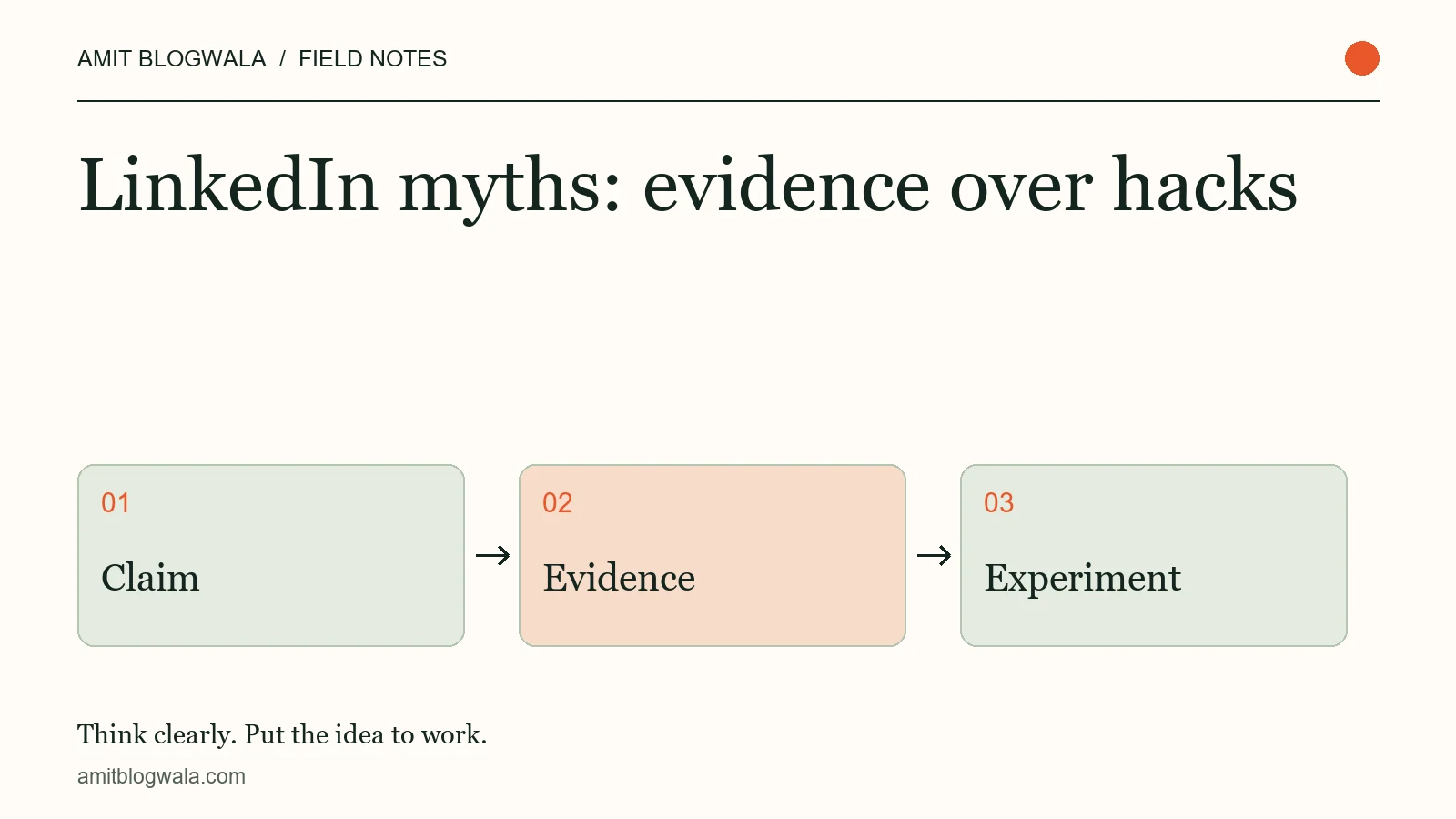
Write the specific claim rather than repeating a vague growth rule.
Check LinkedIn's own guidance and separate it from an individual account's experience.
Compare similar posts against a business objective, recording context and useful responses.
LinkedIn advice often turns a useful observation into a universal rule. That makes it difficult to decide what applies to your own business.
Here are nine assumptions worth questioning, with practical alternatives. These are not guaranteed ranking formulas. Where a point refers to LinkedIn’s published position, the source is linked.
Myth 1: Engagement pods and comment hacks still work
An engagement pod coordinates reactions or comments to make posts appear more popular. It is a poor foundation for a credible professional presence.
LinkedIn has publicly described action against engagement pods and automation, including warnings and possible account restrictions. That does not establish a universal reach penalty or recovery timetable for every account. Read LinkedIn’s explanation of authentic content and conversations.
Instead, engage where you have something specific to add: a relevant question, a useful example or a different perspective. The aim is a real professional conversation.
Myth 2: Putting a link in your post kills your reach, so hide it in the comments
A fixed percentage penalty for every external link is not established by the sources linked here. Hiding every useful link in a comment should not be treated as a universal rule either.
Make the post useful on its own, then include a relevant destination when it helps the reader take the next step. Test placement against your own objectives and comparable posts. Record useful clicks and enquiries alongside impressions.
Choose a post, article or newsletter because the format fits the idea—not because a format guarantees distribution.
Myth 3: You have to post daily or the algorithm forgets you
You need a rhythm you can sustain, not an unsupported promise that a particular weekly frequency wins for every account.
Start with a manageable schedule and review both the quality of the work and the response. If daily posting leaves no time for useful thinking or conversation, adjust the schedule.
- Give each post one clear idea.
- Use a concrete example or a point of view you can explain.
- Make the opening relevant to the intended reader.
- Finish with an appropriate question or next step.
Increase frequency only when you can maintain the quality and workload. Treat your results as observations, not proof of a universal algorithm rule.
Myth 4: AI-written content gets automatically flagged and penalized
Using AI and publishing generic content are different issues. Do not assume that AI use alone proves a penalty, or that every edited AI draft will perform well.
LinkedIn has discussed reducing generic content and automated interactions while emphasizing authentic professional contributions. Read LinkedIn’s guidance on keeping conversations real.
Use AI for a first structure or alternative phrasing if it helps. Check facts, remove invented examples, protect private information and add your own experience. You remain responsible for the final post.
Myth 5: You need a huge following before your content is worth anything
A follower count does not tell you whether the people reading are relevant to your business. A smaller audience can still contain useful relationships; a large audience does not guarantee enquiries.
Define the people you want to help and the questions you can answer for them. Publish work that gives those people a reason to understand and remember your expertise.
Review audience fit, useful responses and conversations rather than waiting for an arbitrary follower milestone before you begin.
Myth 6: A viral post means your strategy is working
High reach is a distribution result. It is not, by itself, a business result.
Before celebrating or dismissing a post, ask what it was meant to achieve. An educational post may answer an important buyer question. An offer post may help someone decide whether to enquire. Those outcomes require different evidence.
Track the next steps you can actually observe: relevant replies, visits to the right offer, qualified enquiries and booked conversations. Attribute client outcomes carefully rather than assuming that a popular post caused them.
Myth 7: You have to choose between being an expert and being human
You can explain your expertise through real experiences without sharing private details or manufacturing vulnerability.
A client question you have permission to discuss, a decision you changed your mind about, or a lesson from doing the work can make an idea concrete. Keep other people’s confidentiality intact.
Use personal context when it helps the reader understand the professional point. There is no verified universal ratio of personal posts to expert posts in this article.
Myth 8: You have to be a natural extrovert or self-promoter to grow
You do not need to adopt a loud persona to communicate clearly. Written explanations, thoughtful questions and useful examples are all ways to share what you know.
This is a working approach, not a claim that LinkedIn’s algorithm rewards one personality type over another. Choose a format you can sustain and improve through feedback.
Build a presence that reflects how you actually think and work. A credible point of view is easier to maintain than a performance you do not enjoy.
Myth 9: If your reach ever drops, there’s nothing you can do about it
A reach drop alone does not prove a shadowban or identify its cause. Comparing one post with another can mix differences in topic, audience, timing and format.
Review the account’s notifications, recent activity and content before drawing a conclusion. If LinkedIn has restricted the account, use its official support or appeal process. Do not rely on a promised one- or two-week recovery schedule.
Record a series of comparable posts and the responses they receive. Check both platform metrics and the business outcomes you care about, then make one clear adjustment at a time.
The Real Reason Behind These LinkedIn Myths
The useful shift is from looking for a guaranteed trick to building a process you can review: a clear offer, an understandable profile, relevant content and thoughtful follow-up.
That process does not guarantee leads or remove the need for judgement. It gives you a way to see what you did, what happened and what you should change.
Editorial note, updated 15 October 2026: this article has been revised to remove unsupported percentage penalties and fixed recovery claims. Practical recommendations are distinguished from LinkedIn’s published statements.
Further reading: LinkedIn’s best practices for sharing content.
Turn the ideas into a working system
The 30-day LinkedIn System Sprint provides structured materials, AI prompts and tracking for work you implement yourself. If you want a team to coordinate the execution, explore The Quiet Turtle’s core 90-day service.
Not sure where to start? Request a free 30-minute conversation with Amit, or use the blog.
About the author: Amit Blogwala works on personal branding, LinkedIn and practical business systems, and runs The Quiet Turtle. Connect on LinkedIn.
Sources and context
This is practical editorial guidance, not a tested guarantee of rankings, leads, sales or income. The right approach depends on your audience, resources and actual results.
Sources provide product, policy or background context; the application framework above is an editorial recommendation. Links reviewed 17 October 2026.
Continue with more articles from Amit, or explore the current ways to work together.