THE USEFUL ANSWER
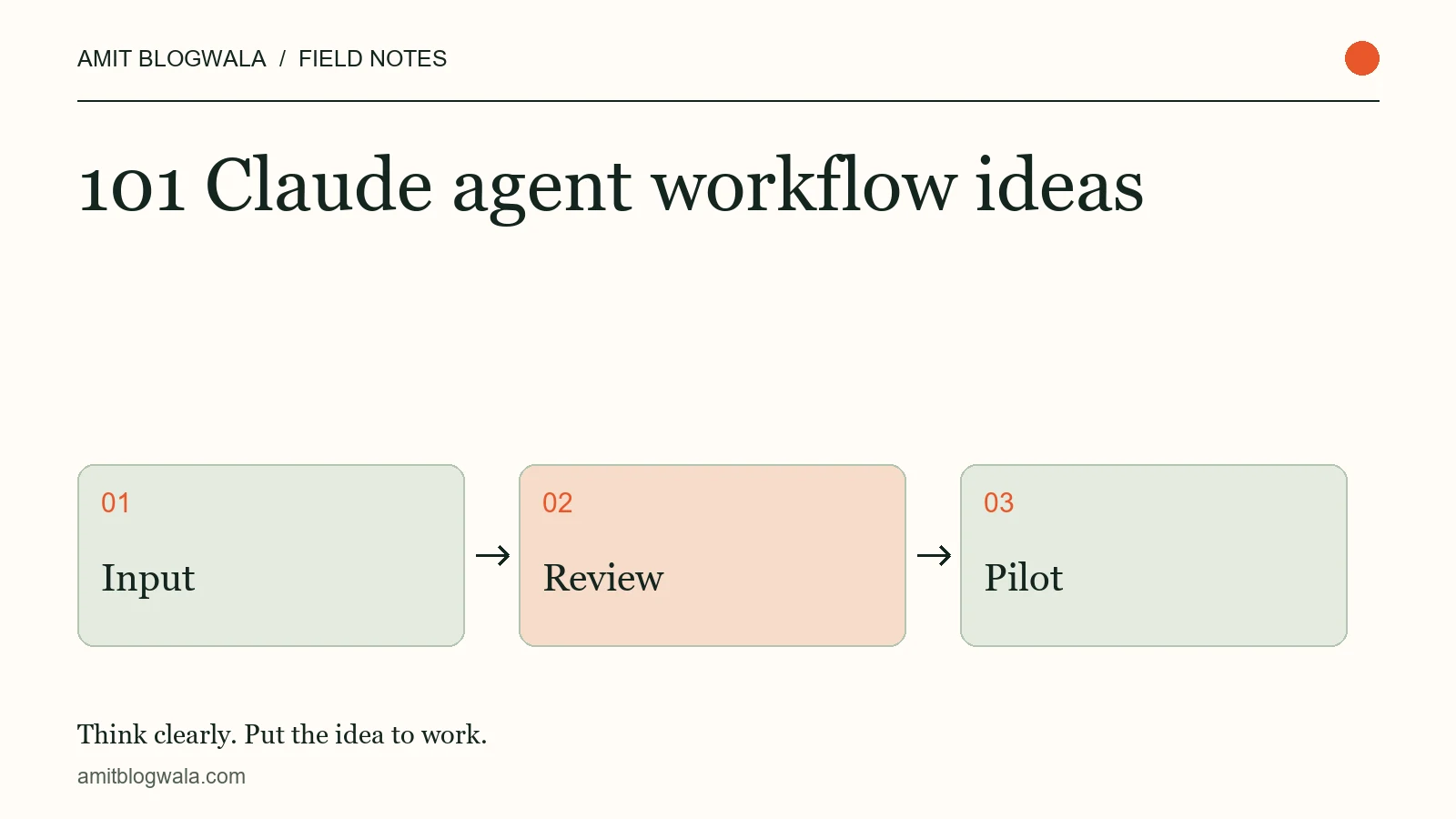
Claude agent ideas become useful when a repeatable task has reliable inputs, a defined output and a human review point. The use cases in this article are possibilities to assess, not proof of autonomous capability, time savings or suitability for every business.
Specify the permitted documents, data and tools needed for one task.
Define an acceptance check and who handles missing or conflicting information.
Test a small set of representative cases before allowing consequential actions.
Quick answer: Claude agents can support repeatable founder tasks such as research, content preparation, sales administration and documentation. Start with one clearly defined workflow, provide reliable inputs, and review the output before using it in business decisions. The examples below are workflow ideas, not promises of autonomous execution.
101 Practical Claude Agent Use Cases for Founders
Most founders are not short of ideas.
They are short of time, attention, and execution bandwidth.The founder becomes the bottleneck for everything.- Research waits.
- Hiring waits.
- Content waits.
- Sales follow-ups wait.
- Customer support waits.
- Investor updates wait.
- Internal documentation waits.
- Decision-making slows down.
First, What Are Claude Agents?
Claude agents are AI-powered assistants that can be set up to handle specific types of work.You can use them to research, analyze, summarize, draft, compare, organize, review, and help execute repeatable workflows.But here is the important part:They are not magic.They need clear instructions. They need context. They need review. They need boundaries. They need examples of what good output looks like.A weak founder will use agents like toys.A serious founder will use them like operating systems.How Founders Should Think About Claude Agents
Do not ask, “What can AI do?”That question is too broad.Ask this instead:“What work keeps repeating in my business, but still depends too much on me?”That is where agents help.Look for work that is:- Frequent
- Time-consuming
- Research-heavy
- Writing-heavy
- Analysis-heavy
- Process-driven
- Important, but not always strategic
- Easy to define with examples
101 Ways Founders Can Use Claude Agents
1. Strategy and Decision-Making
- Analyze a new business idea before investing time or money.
- Compare multiple startup ideas based on market size, ease of execution, competition, and monetization potential.
- Turn a rough founder thought into a clear strategic memo.
- Create a decision matrix for choosing between product features.
- Evaluate whether a business should focus on B2B, B2C, or B2B2C.
- Review a go-to-market plan and identify weak assumptions.
- Analyze whether a company should enter a new market.
- Create a one-page strategy brief before a leadership meeting.
- Break a large business goal into quarterly priorities.
- Identify risks in a new product, market, hiring, or funding decision.
- Compare two positioning strategies and recommend the stronger one.
- Turn founder intuition into a structured business hypothesis.
- Create a “what could go wrong” analysis before launching a campaign.
- Review a pitch, proposal, or plan from an investor’s point of view.
- Convert scattered notes into a clear execution roadmap.
2. Market Research and Competitive Intelligence
- Research competitors and summarize their positioning.
- Compare competitor pricing models.
- Analyze competitor websites and identify their strongest messaging.
- Track competitor product updates and summarize what changed.
- Build a market landscape document for a new industry.
- Identify customer segments within a market.
- Research industry trends and turn them into founder-level insights.
- Summarize long reports into decision-useful takeaways.
- Create a competitor comparison table.
- Identify gaps in competitor messaging.
- Analyze customer reviews of competing products.
- Extract pain points from online forums, reviews, and social comments.
- Create a market-entry brief for a new geography.
- Identify underserved niches in a crowded market.
- Build a research summary before a sales or investor call.
3. Content and Personal Branding
- Turn founder opinions into LinkedIn posts.
- Convert long blogs into short social posts.
- Convert one idea into a full content calendar.
- Rewrite technical ideas into simple founder-friendly language.
- Create hooks for LinkedIn posts, carousels, and threads.
- Turn customer conversations into content ideas.
- Convert internal strategy into public thought leadership.
- Repurpose a webinar or podcast transcript into posts.
- Create blog outlines based on business goals.
- Rewrite weak content in a sharper founder voice.
- Create content pillars for a founder’s personal brand.
- Analyze top-performing posts and identify patterns.
- Create a weekly newsletter draft.
- Turn product updates into launch content.
- Create a content distribution plan for each article.
4. Sales and Business Development
- Research a prospect before a sales call.
- Create a custom outreach message for a specific buyer.
- Draft cold email sequences for different customer segments.
- Rewrite sales messages to sound more direct and less desperate.
- Summarize sales call notes and extract next steps.
- Create objection-handling responses.
- Build a discovery call question bank.
- Analyze why a deal may be stuck.
- Create follow-up emails after meetings.
- Research decision-makers inside a target account.
- Build an account-based sales brief.
- Create a proposal outline based on client requirements.
- Turn a product feature list into customer benefits.
- Create a sales script for a new offer.
- Review sales collateral and identify unclear messaging.
5. Marketing and Growth
- Create campaign ideas for a product launch.
- Analyze landing page copy and suggest improvements.
- Draft ad copy variations for different audiences.
- Create lead magnet ideas for a target market.
- Build a simple funnel strategy.
- Analyze why a landing page may not convert.
- Turn customer pain points into campaign angles.
- Create email nurture sequences.
- Write product announcement emails.
- Build positioning statements for different customer segments.
- Create a messaging framework for a new product.
- Review website copy for clarity and conversion.
- Create a brand voice guide.
- Suggest campaign themes for a 30-day launch.
- Convert product features into marketing claims.
6. Hiring and Team Building
- Draft job descriptions for new roles.
- Create scorecards for candidate evaluation.
- Screen resumes against role requirements.
- Prepare interview questions for specific roles.
- Create practical assignments for candidates.
- Summarize interview notes.
- Compare shortlisted candidates.
- Draft onboarding plans for new hires.
- Create role clarity documents.
- Write internal SOPs for recurring work.
- Build a 30-60-90 day plan for a new employee.
- Create training material for junior team members.
- Draft internal policies.
- Identify what work should be hired for versus automated.
- Build a lean team structure for the next 6 months.
7. Operations and Documentation
- Turn messy processes into SOPs.
- Create checklists for recurring work.
- Summarize meeting notes into action items.
- Create project plans from rough instructions.
- Track dependencies across teams.
- Convert founder instructions into process documents.
- Create internal knowledge base articles.
- Review documents for missing information.
- Create weekly business review templates.
- Turn repeated questions into internal FAQs.
- Build operating dashboards and reporting formats.
The Best Way to Start
Do not start with all 101 ideas.That is how founders turn useful tools into another distraction.Start with one painful bottleneck.Ask yourself:“What is the work I keep delaying because it needs my brain, but not always my presence?”That is your starting point.For most founders, the best first use cases are:- Sales follow-ups
- Competitor research
- LinkedIn content
- Meeting summaries
- SOP creation
- Hiring scorecards
- Investor update drafts
- Customer pain point analysis
- Proposal writing
- Landing page review
A Simple Claude Agent Workflow for Founders
Here is a clean workflow you can use.Step 1: Pick One Repeated Task
Do not automate random work.Pick something you do every week.Example:“I research prospects before sales calls.”Step 2: Define the Output
Be specific.Bad:“Do prospect research.”Better:“Create a one-page prospect brief with company overview, buyer role, recent updates, likely pain points, possible objections, and suggested opening questions.”Step 3: Give Context
Claude agents work better when they understand your business.Give them:- Your company description
- Your target audience
- Your product or service
- Your pricing
- Your positioning
- Examples of past good work
- What to avoid
Step 4: Create a Repeatable Prompt
The prompt should not change every time.The input changes. The process stays the same.Step 5: Review and Improve
Do not expect perfect output on day one.Review the first few outputs carefully.Improve the prompt. Add examples. Remove weak instructions. Tighten the format.That is how agents become useful.Where Founders Go Wrong With AI Agents
Most founders make three mistakes.Mistake 1: They Use Agents Without Process
If your process is messy, AI will make the mess faster.Fix the workflow first.Then use agents.Mistake 2: They Expect Final Output Without Review
Agents are useful assistants, not final decision-makers.Use them to prepare work.You still own the decision.Mistake 3: They Chase Tools Instead of Use Cases
The tool is not the strategy.The use case is the strategy.A founder with one strong workflow will get more value than a founder testing 20 AI tools every week.What Claude Agents Can Actually Help You Scale
Claude agents can help you scale five things.1. Research
They reduce the time needed to understand markets, competitors, customers, and opportunities.2. Thinking
They help structure messy ideas into clear options, trade-offs, and decisions.3. Writing
They help draft content, proposals, emails, updates, SOPs, and internal documents.4. Review
They help identify gaps, weak logic, unclear messaging, and missing information.5. Execution
They help move repeatable work forward without waiting for the founder every time.That is the real leverage.Not replacing people.Not removing judgment.Reducing the founder’s operational load.My Recommendation
If you are a founder, do not use Claude agents as a toy.Use them as a system.Pick 5 use cases from this list.Build one workflow for each.Start with the work that saves time, improves quality, or removes founder dependency.Here is the order I would recommend:- Competitor research agent
- LinkedIn content agent
- Sales follow-up agent
- Meeting summary agent
- SOP creation agent
Final Thought
Claude agents are not about doing more random work.They are about building a business that depends less on founder memory, founder availability, and founder follow-up.That is the real shift.A founder should not be the only person who knows how things work.A founder should build systems that carry the thinking forward.Claude agents can help with that.But only if you use them with discipline.Start small.Pick one bottleneck.Turn it into a workflow.Then improve it every week.Sources and context
This is practical editorial guidance, not a tested guarantee of rankings, leads, sales or income. The right approach depends on your audience, resources and actual results.
Sources provide product, policy or background context; the application framework above is an editorial recommendation. Links reviewed 17 October 2026.
Continue with more articles from Amit, or explore the current ways to work together.