How Claude Agents Help Sales Teams Scale Outreach Without Hiring
Your sales bottleneck is rarely closing deals.
It is everything that happens before the close that needs fixing.
Lead qualification. Prospect research. CRM updates. Competitive analysis. Follow-ups. Proposal drafting. Meeting notes.
Individually, these tasks seem small. Together, they consume hours every week.
Most companies respond by hiring a BDR or sales operations specialist. Sometimes that’s the right move. Often, it isn’t.
Many teams don’t need another hire yet. They need a better system.
Claude agents can handle a large portion of the repetitive work surrounding sales, allowing founders and revenue teams to spend more time on conversations, relationships, and closing opportunities.
The key is knowing what should be automated and what should remain human.
The Real Problem With Sales Automation
Most sales automation fails because teams try to automate judgment.
An agent can determine whether a lead matches predefined criteria.
An agent cannot reliably determine whether someone is genuinely interested in buying.
An agent can draft a follow-up email.
An agent cannot build trust with a prospect.
This distinction matters.
Bad automation attempts to replace sales judgment.
Good automation removes administrative work and surfaces better information.
The rule is simple:
Automate repetitive tasks. Keep judgment, relationships, and decision-making human.
When teams follow that rule, automation becomes a force multiplier instead of a source of frustration.
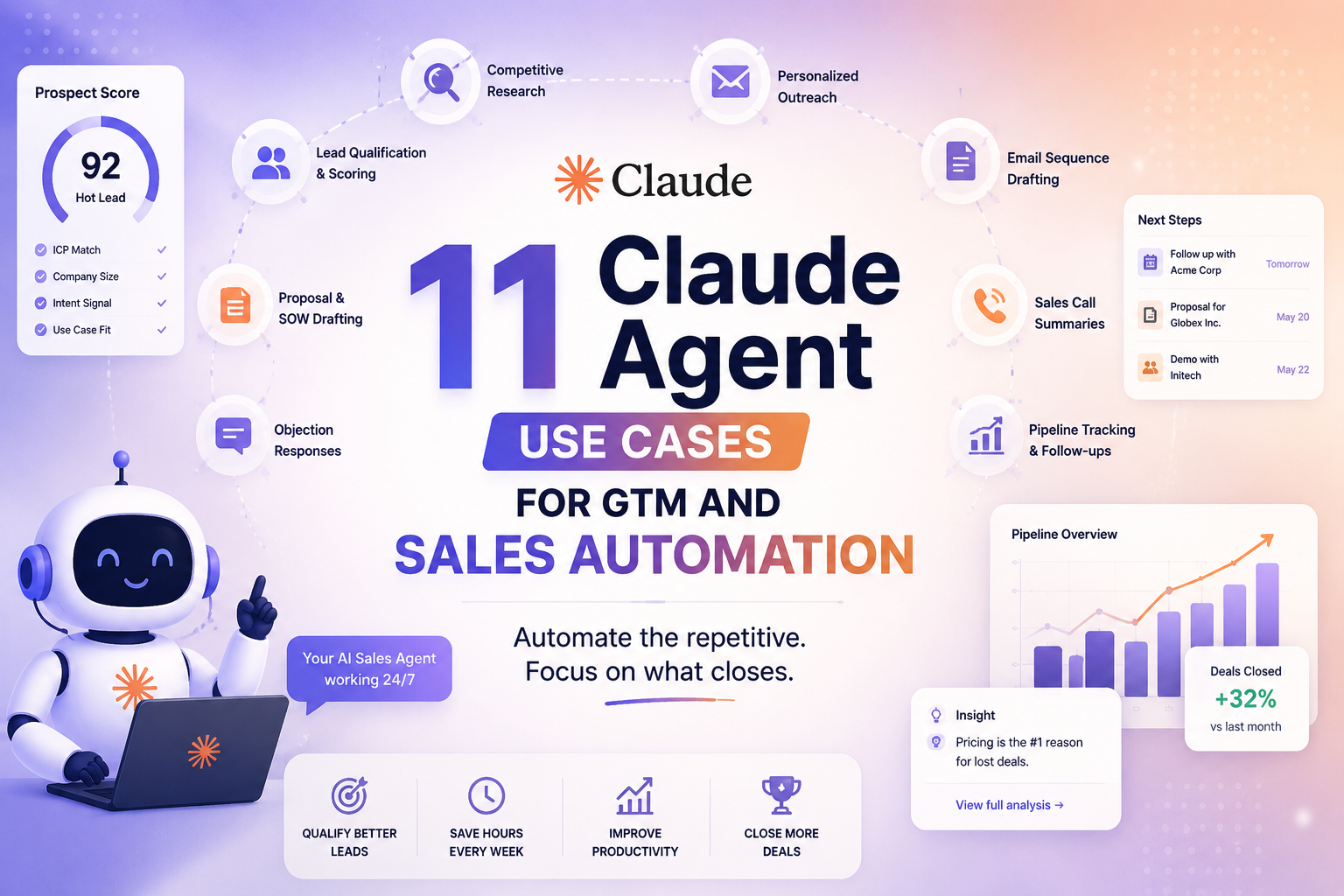
11 Claude Agent Use Cases for GTM and Sales Teams
1. Lead Qualification and Scoring
Priority: Start Here
New leads arrive from forms, events, referrals, webinars, and partnerships.
Instead of manually reviewing every lead, an agent evaluates them against your Ideal Customer Profile (ICP).
Typical factors include:
- Company size
- Industry
- Job title
- Geography
- Budget indicators
- Use case fit
- Buying intent
The output is a ranked list of leads categorized as hot, warm, or cold.
Potential impact
- Faster response to qualified opportunities
- Better prioritization
- Reduced manual triage
2. Sales Call Summaries and CRM Updates
Priority: Start Here
Sales reps often spend valuable time documenting meetings after they happen.
A Claude agent can convert call transcripts into structured summaries, including:
- Key pain points
- Stakeholders involved
- Decision criteria
- Risks and objections
- Next steps
- Follow-up commitments
The summary can be copied directly into your CRM.
Potential impact
- More time spent selling
- Better follow-up quality
- More consistent CRM hygiene
3. Follow-Up Tracking and Next-Step Reminders
Priority: Start Here
Many opportunities are lost because follow-ups never happen.
An agent can track commitments and remind team members when action is required.
Example:
- Prospect requested pricing next Tuesday
- Demo scheduled in two weeks
- Legal review pending
Instead of relying on memory, the agent keeps opportunities moving.
Potential impact
- Fewer stalled deals
- Better accountability
- Improved pipeline discipline
4. Competitive Research and Battlecards
Priority: High
Prospects frequently compare vendors before making decisions.
Instead of spending an hour researching competitors before every meeting, an agent can generate a battlecard covering:
- Positioning
- Strengths
- Weaknesses
- Pricing models
- Typical customer profile
- Competitive differentiators
Potential impact
- Faster meeting preparation
- More consistent positioning
- Better objection handling
5. Personalized Outreach Preparation
Priority: Medium
Personalization works.
Manual personalization at scale does not.
A Claude agent can prepare outreach insights by reviewing:
- Company websites
- Recent announcements
- Funding events
- Hiring activity
- Product launches
Instead of writing every email from scratch, reps start with relevant context.
Potential impact
- Faster prospecting
- More relevant messaging
- Better first-touch quality
6. Email Sequence Drafting
Priority: Medium
Most outbound campaigns follow a predictable structure.
A Claude agent can generate:
- Initial outreach emails
- Follow-up sequences
- Re-engagement campaigns
- Event follow-ups
- Demo reminder emails
The sales team reviews and edits before sending.
Potential impact
- Less writing time
- Faster campaign execution
- More consistent messaging
7. Objection Response Libraries
Priority: Medium
Prospects tend to raise the same concerns repeatedly.
Examples include:
- “We’re already using another solution.”
- “The budget isn’t approved.”
- “We need to wait until next quarter.”
A Claude agent can generate response frameworks for common objections and organize them into an internal knowledge base.
Potential impact
- Faster responses
- More consistent positioning
- Reduced dependence on tribal knowledge
8. Proposal and Statement of Work Drafting
Priority: Medium
Proposal creation is often repetitive.
An agent can assemble draft proposals using approved templates, pricing structures, delivery timelines, and scope descriptions.
Human review remains essential.
Potential impact
- Faster turnaround
- More professional proposals
- Less founder involvement in routine deals
9. Win/Loss Analysis
Priority: Advanced
After enough opportunities accumulate, patterns emerge.
Claude can analyze sales notes, lost opportunities, and customer feedback to identify:
- Pricing issues
- Feature gaps
- Competitor pressure
- Timing challenges
- Qualification problems
Potential impact
- Better strategic decisions
- Improved positioning
- Clearer product priorities
10. Market Intelligence Monitoring
Priority: Advanced
Revenue teams often struggle to keep up with market changes.
A Claude-powered workflow can track:
- Competitor announcements
- Product releases
- Pricing updates
- Job postings
- Industry trends
The result is a regular digest instead of hours of manual research.
Potential impact
- Better market awareness
- Faster competitive response
- More informed strategy discussions
11. Customer Persona Development
Priority: Advanced
Many buyer personas are built from assumptions.
Claude agents can analyze interview transcripts, discovery calls, surveys, and customer feedback to identify:
- Common pain points
- Buying triggers
- Decision-makers
- Success metrics
- Industry patterns
The result is a persona based on actual customer data.
Potential impact
- Better targeting
- Better messaging
- Stronger GTM alignment
What Not to Automate
This is where many teams go wrong.
Just because an agent can generate something does not mean it should own the decision.
Keep the following human:
- Enterprise negotiations
- Pricing discussions
- Final proposal approval
- Strategic account management
- Relationship building
- Executive conversations
- Complex objection handling
- Contract redlining
- Deal closing
These activities depend on trust, context, and judgment.
Agents can support them.
They should not replace them.
The Fastest First Win: Lead Qualification
If you’re deploying your first GTM agent, start with lead qualification.
It has:
- Clear inputs
- Clear rules
- Low implementation risk
- Immediate value
Step 1: Define Your ICP
Create 5 to 7 scoring criteria.
Example:
| Criteria | Score |
|---|---|
| Ideal company size | +2 |
| Target industry | +2 |
| Decision-maker title | +2 |
| Clear pain point | +2 |
| Buying intent signal | +2 |
Then define thresholds:
- 7+ = Hot
- 4-6 = Warm
- Below 4 = Cold
Step 2: Train the Agent
Provide examples of previously qualified leads.
Show:
- The lead
- The score
- The reasoning
This teaches the agent your qualification standards.
Step 3: Validate Results
Run a batch of recent leads through the system.
Compare agent scores against human scores.
Aim for consistency, not perfection.
If the agent reaches roughly 80% agreement with your judgment, it is likely ready for production use.
Step 4: Make It Part of the Daily Workflow
Run new leads through the process each day.
Focus human effort on the highest-priority opportunities.
The Hard Truth About Sales Automation
Automation does not fix weak sales execution.
It does not create urgency.
It does not build trust.
It does not improve poor positioning.
What it does is remove administrative work that distracts good salespeople from selling.
The strongest sales teams use automation to increase leverage.
The weakest sales teams use automation hoping it will replace discipline.
Those are very different outcomes.
Where to Go Next
Once lead qualification is working reliably, expand gradually.
Recommended sequence:
- Lead qualification
- Call summaries and CRM updates
- Follow-up tracking
- Proposal drafting
- Competitive research
- Outreach personalization
- Advanced analytics and market intelligence
Start with one workflow.
Measure the results.
Improve it.
Then move to the next bottleneck.
That approach scales far better than trying to automate everything at once.
Claude agents are not a replacement for great salespeople.
They are a way to ensure great salespeople spend more time selling.
———————————————————————————————————————-
FAQ
What are Claude agents in sales?
Claude agents are AI-powered workflows that help sales teams automate repetitive tasks such as lead qualification, research, CRM updates, proposal drafting, and follow-up tracking.
Can Claude agents replace sales representatives?
No. Claude agents can support sales teams by reducing administrative work, but relationship building, negotiation, and closing deals still require human judgment.
What is the best first sales automation use case?
Lead qualification is usually the easiest starting point because it has clear inputs, scoring criteria, and measurable outcomes.
How much time can Claude agents save sales teams?
The impact varies by workflow, but teams commonly use agents to reduce time spent on research, documentation, reporting, and administrative tasks.
Should startups automate sales before hiring?
In many cases, yes. Automating repetitive processes can help founders and early sales teams increase capacity before adding headcount.