THE USEFUL ANSWER
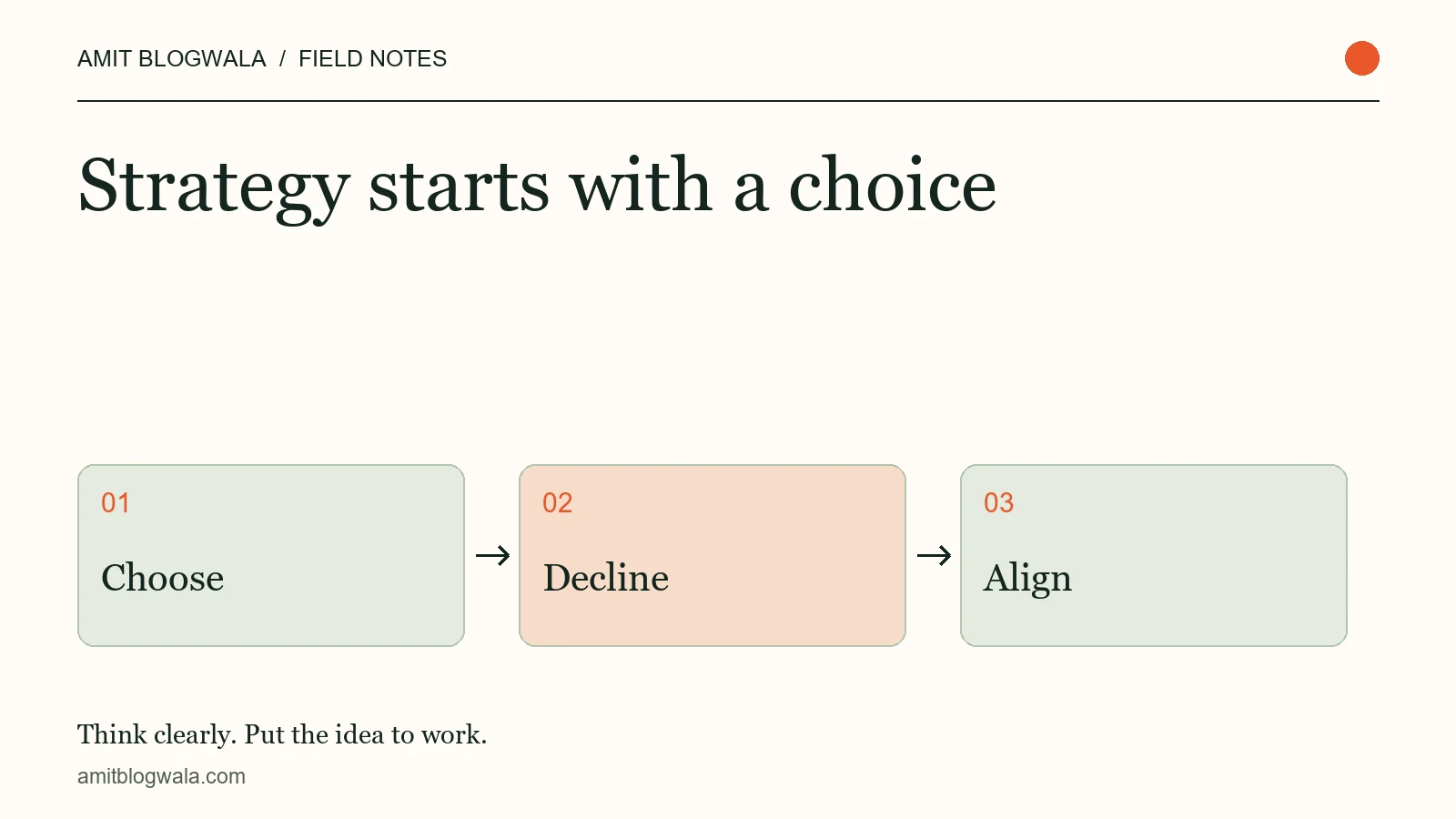
A strategy makes choices about where to focus and what to decline. A plan translates those choices into actions, owners and checkpoints. Both matter: a busy schedule without a strategic choice can spread attention across incompatible priorities.
State the audience, problem and advantage you will concentrate on.
List the attractive opportunities you will not pursue within this period.
Check whether the calendar, budget and success measures reflect the choice.
Factual review: 16 October 2026. Replaced unsupported product-count statistics and a claim about Jobs’s lack of planning with a documented product-strategy reference.
If your to-do list is growing but your clarity isn’t—
That’s not strategy.
That’s survival.
Somewhere along the way, we confused “doing more” with “doing it right.”
But real strategy doesn’t begin with a plan.
It begins with a pause.
And a hard look at what you’re chasing that’s quietly draining you.
We’re all taught to believe that strategy is about having a plan.
👉A big plan.
👉A bold plan.
A beautiful Notion page full of timelines, color-coded funnels, and KPIs.
But let me tell you something I learned the hard way:
Strategy isn’t about planning what to chase.
It’s about choosing what you’ll let go of.
The Lie of “More”
If you’re anything like me, you’ve tried chasing multiple things at once.
👉The podcast idea.
👉The side hustle.
👉The newsletter.
👉The product launch.
👉The Instagram growth.
The “you should be on YouTube!” advice from that one guy on LinkedIn.
And suddenly you’re running in 6 directions and still not moving.
You know what that feels like?
It feels like busy. But not aligned.
Like progress on paper but confusion in your gut.
And strategy — real strategy — begins when you stop asking:
“What else can I add?”
And start asking:
“What do I not want to become?”
Look at Apple
Apple’s 1998 product-strategy announcement described two portable and two desktop product lines for consumer and professional markets. See Apple’s contemporary announcement. The useful theme here is focus, rather than an unsupported product count or claim that no planning was involved. My interpretation is:
“Let’s stop making things we’re not great at.”
That’s not just minimalism.
That’s strategy.
Because strategy isn’t about ambition.
It’s about focus with consequences.
My Strategy? One Truth at a Time.
I used to think I had to offer everything.
Courses. Copywriting. Coaching. Branding. Newsletters. Podcasts.
I was constantly tweaking plans, experimenting with formats, adding more “value.”
But I was also losing my voice.
Now?
I write.
That’s it.
Truths, one at a time.
In a way that speaks to one person — maybe you.
And that clarity didn’t come from planning more.
It came from choosing less.
A Question for You
What are you currently chasing that isn’t truly yours?
The algorithm?
The expectations of others?
The hustle-noise of everyone telling you what you should do?
What if you paused?
What if you stopped building plans for a minute…
And instead, decided what you’re willing to walk away from?
Because your real strategy?
It begins when you stop being everything for everyone.
And start becoming exactly who you’re meant to be — for someone who needs it most.
You Don’t Need More. You Need Less That’s Yours.
So no — strategy isn’t a plan.
It’s not the fancy whiteboard.
Not the 10-tab spreadsheet.
Not even the 90-day content calendar (though those help after clarity).
Strategy is the sacred decision to not chase what doesn’t feel like home.
And the courage to stand still, while everyone else runs after the next shiny thing.
If this made you stop and reflect, then maybe that’s your strategy whispering to you.
Listen.
Sources and context
This is practical editorial guidance, not a tested guarantee of rankings, leads, sales or income. The right approach depends on your audience, resources and actual results.
Sources provide product, policy or background context; the application framework above is an editorial recommendation. Links reviewed 17 October 2026.
Continue with more articles from Amit, or explore the current ways to work together.